


Meet Felicia who works on the EULiST course catalogue
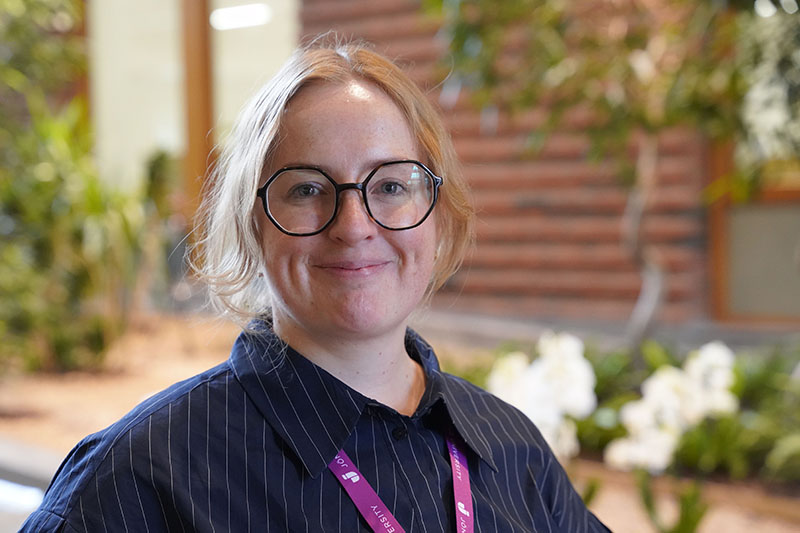
As an Academic officer at the Department of Educational Support at Jönköping University (JU), Felicia Säfsten works to develop educational opportunities within EULiST. A key part of her work is the joint course catalogue, which is designed to make it easier for students to access courses and gain international experience at EULiST’s partner universities.
Felicia has been involved with EULiST since March 2025 and works with EULiST Agora for Education, a joint platform for courses, teaching support and lifelong learning within the alliance.
She is also a member of a working group on credit transfer, the Recognition Framework. Among other things, the group has mapped and analyzed processes for mobility and credit transfer at partner universities. This work has highlighted good practices within the alliance and contributed to a better understanding of how mobility can be made smoother and more accessible for students.
“It comes as no surprise that JU is taking the lead in having a very digitized and good process for this”, Felicia says.
Felicia is also one of JU's editors for the course catalogue. This includes collaborating with the schools at JU to identify courses that can be made available to students. Within the alliance, she is involved in discussions on how the course catalogue can be linked to the partner universities’ local systems for admissions and credit recognition.
JU recently hosted a workshop with EULiST colleagues from the Teaching and Learning work package. What were the main topics and outcomes?
“One of our main topics was to agree on a plan for The EULiST Agora for Education. The platform is intended to serve as a shared space for resources, knowledge and educational opportunities within the alliance. A key lesson is just how much we actually achieve – and the added value that collaboration brings – when we meet in person.
EULiST has now launched a joint course catalogue. What does it mean for students?
“It gives students the opportunity to discover what our partner universities have to offer beyond a traditional exchange semester. The course catalogue now includes shorter mobility programmes, thereby making international experiences accessible to a wider group of students.”
Through EULiST, you’ve gained new colleagues across Europe. What do you appreciate most about working in such an international environment?
“Building relationships and truly becoming digital colleagues. Gaining an insight into everyday life in the different countries where we live, whilst at the same time gaining a better understanding of how our higher education institutions operate behind the scenes. We talk about what sets us apart, but also about everything we have in common. It’s also inspiring to work together to develop ideas that can improve and facilitate opportunities for internationalisation for students across the entire alliance.”
What does EULiST mean to you personally?
“It's an opportunity to work in an international environment while still sitting at my desk at JU. I'm inspired by seeing how many committed and driven colleagues there are in the alliance. It gives me hope for the future to see what we can achieve together!”


