

Sophia Engl and Agnetta Nabukenya win the 2026 MMTC Thesis Award
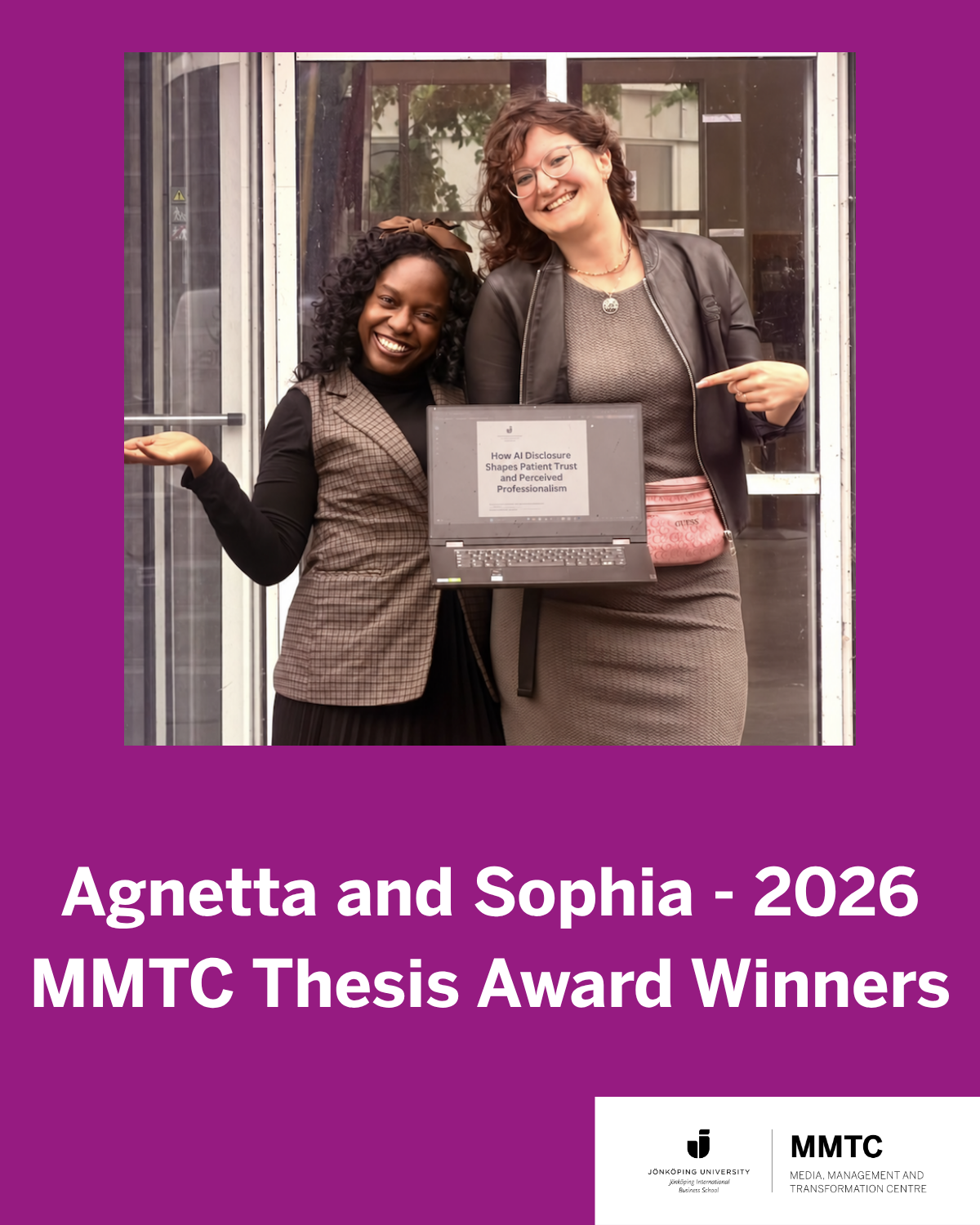
What happens to trust when people learn that the information they receive has been generated by AI? This question is at the heart of the winning thesis in the 2026 MMTC Thesis Award.
MMTC is pleased to announce Sophia Engl and Agnetta Nabukenya as the winners of the 2026 MMTC Thesis Award for their Master's thesis, “How AI Disclosure Shapes Patient Trust and Perceived Professionalism: A Quantitative Study of Health Communication in Germany and Uganda.”
Written as part of the International Marketing programme at Jönköping International Business School, the thesis examines an important challenge emerging as AI becomes increasingly integrated into organisational communication: while transparency about the use of AI is increasingly expected, disclosing AI involvement can itself influence how people evaluate and respond to information.
The transparency dilemma
Sophia and Agnetta investigated this issue in the particularly high-stakes setting of healthcare communication. Their study used an experiment involving 441 participants in Germany and Uganda, who were presented with post-acute discharge instructions attributed either to a human physician or to an AI system. The content of the message remained identical, allowing the researchers to examine the effect of the source disclosure itself.
The results showed that AI disclosure significantly reduced trust, perceived professionalism and willingness to follow the medical advice. Interestingly, however, being told that AI had generated the message did not significantly increase general unease about AI. This suggests that participants were responding to questions of credibility and professional judgement rather than simply reacting negatively to the technology itself.
Context matters
The comparison between Germany and Uganda adds another important dimension to the research. Although the overall disclosure effect was similar across the two samples, the mechanisms behind people's responses differed. In Germany, trust carried the significant pathway between AI disclosure and willingness to follow the advice. In Uganda, perceived professionalism played the significant mediating role. The study therefore challenges the idea that people will respond to AI disclosure in the same way across different settings. Instead, the meaning attached to AI and transparency can be shaped by the institutional and cultural context in which the technology is introduced.
Responsible AI in a transforming communication landscape
These findings have implications extending beyond healthcare. As organisations increasingly use AI in customer, professional and other high-stakes communication, the study highlights a central challenge of digital transformation: being transparent about AI use does not automatically create trust.
Sophia and Agnetta argue that organisations should therefore accompany AI disclosure with clear signals of human oversight, professional responsibility and accountability.
The thesis closely reflects MMTC's interest in understanding how digital innovation transforms organisations, markets and relationships with stakeholders. It also demonstrates how transformation is not simply about adopting new technologies, but about understanding how their introduction changes expectations, perceptions and behaviour.
As winners of the 2026 MMTC Thesis Award, Sophia and Agnetta will each receive a financial reward and have the opportunity to collaborate with MMTC scholars to further develop their research towards a publishable journal article.
Congratulations, Sophia and Agnetta!


