


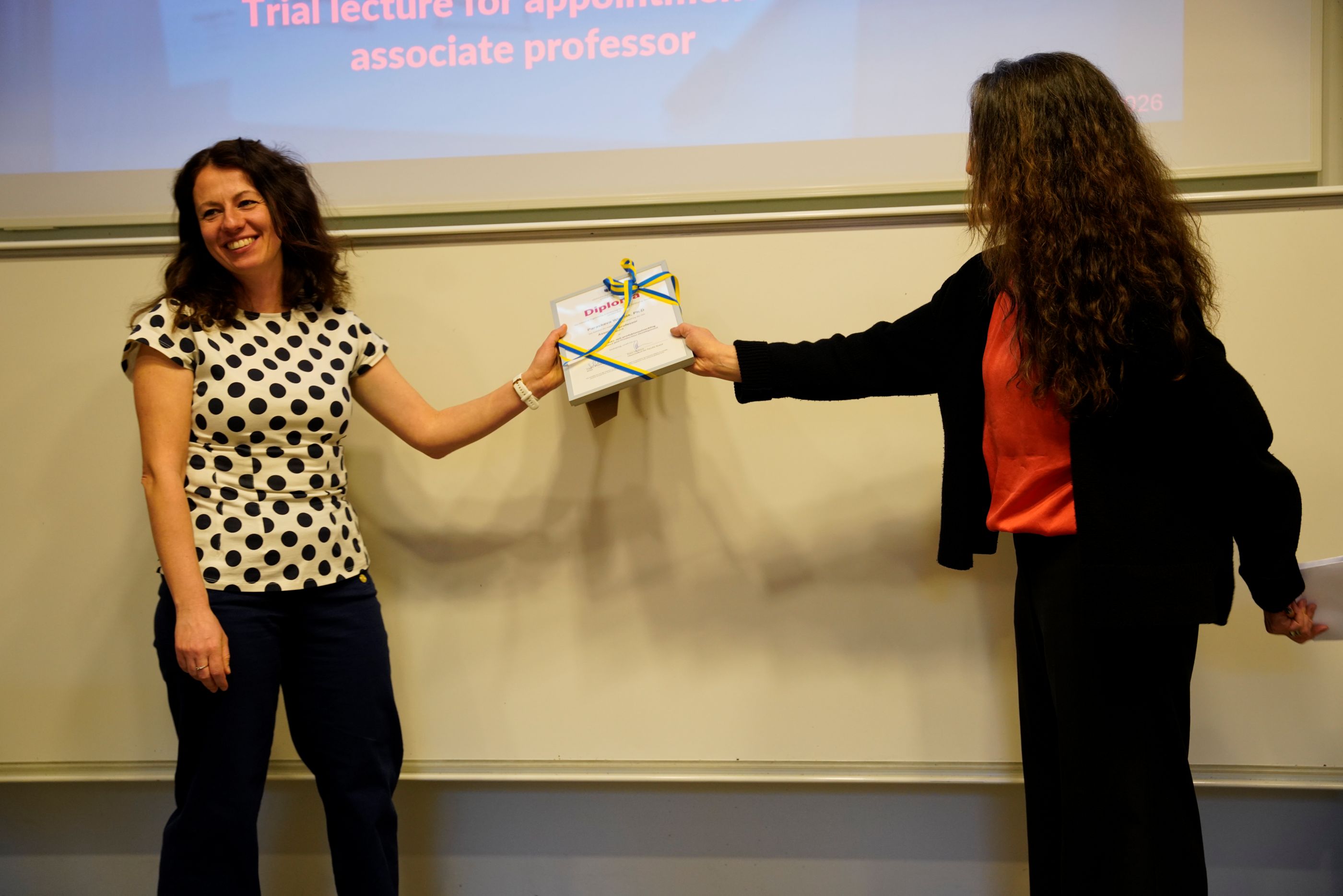
Paraskeva Wlazlak receives a diploma from Annika Moscati, Associate Professor at JTH, certifying that she has passed her trial lecture.
Paraskeva Wlazlak passed her trial lecture – watch slideshow
Paraskeva Wlazlak passed her trial lecture for appointment as Associate Professor at JTH, on 11 March. The title of her lecture was “Integrated Product Realisation for Sustainable Engineering”. The title of her lecture was “Integrated Product Realisation for Sustainable Engineering”.
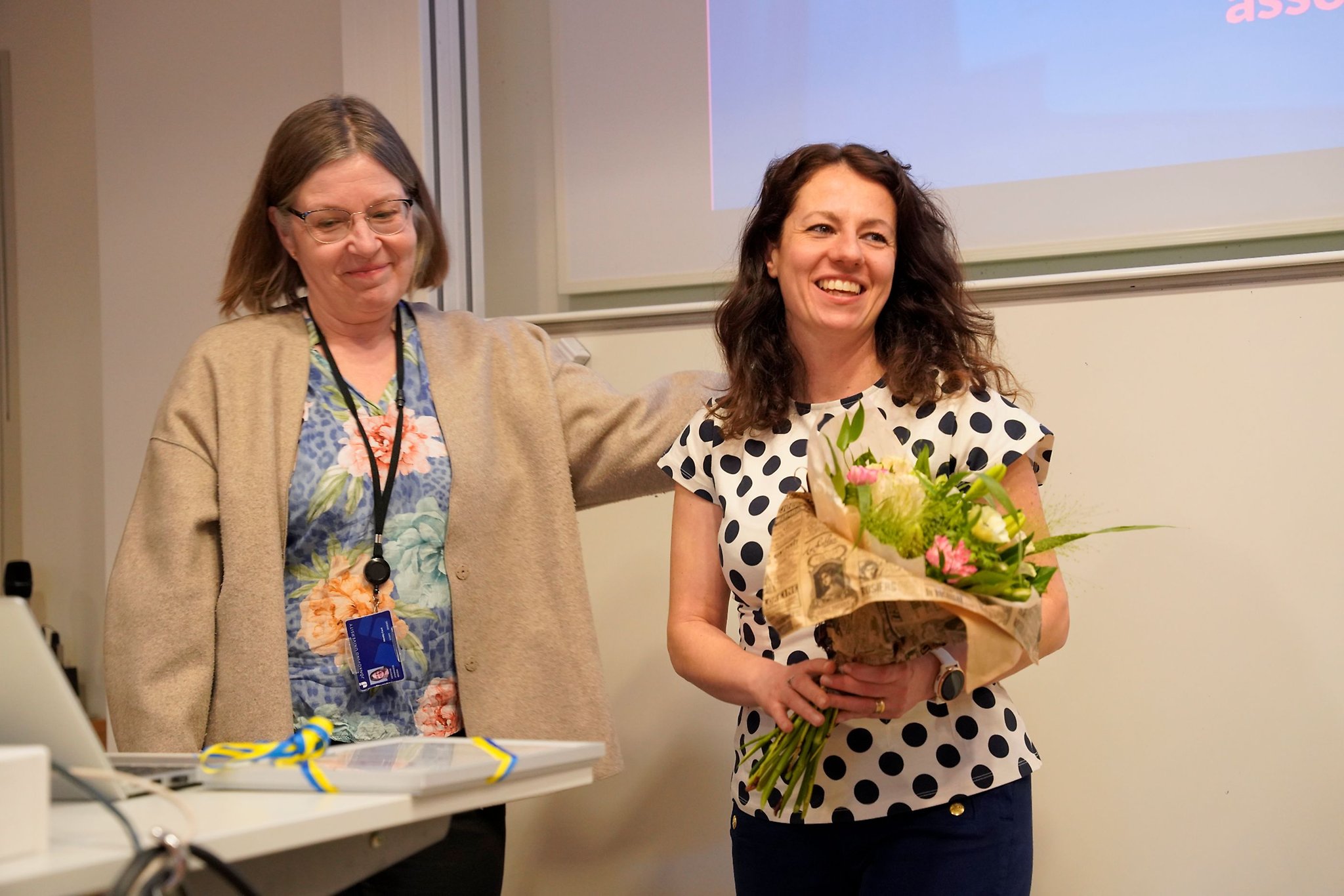
”The main purpose of my research is to help companies design and industrialize products with sustainability built in from the start. I study how product and production development can be better integrated, since most environmental impact is decided early in the process. My work develops methods and tools that help engineers from different disciplines collaborate, share knowledge, and make decisions that balance technical and sustainability requirements. Integrated product realization is important because it brings together design, engineering, production, sustainability, and business considerations early on, when they have the greatest effect. This type of integration helps reduce environmental impact, meet new regulations, and drive innovation”, says Paraskeva Wlazlak.
How does your research benefit industry and/or society?
“Integrated product realization enables companies to develop products that are technically robust, economically viable, and environmentally responsible. It helps reduce waste, improve resource efficiency, and support the transition toward more circular business models. For society, the benefits include products with lower environmental impact, more efficient use of materials and energy, and overall more sustainable solutions”, says Paraskeva.
What conclusions have you reached through your research?
"A key conclusion of my research is that sustainable engineering depends on strong integration across disciplines. Technical tools alone are not enough, companies also need organizational processes and ways of working that support shared understanding, collaboration, and knowledge integration. When engineers from product development, production development, sustainability, and other areas can work together effectively, companies achieve smoother industrialisation, fewer errors, and more sustainable outcomes. My research shows that the right integration mechanisms could help teams make decisions that support circular strategies, reduce waste, and improve overall product and process sustainability."

- Associate Professor Integrated Product and Production Development
- School of Engineering
- paraskeva.wlazlak@ju.se
- +46 36-10 1612


