


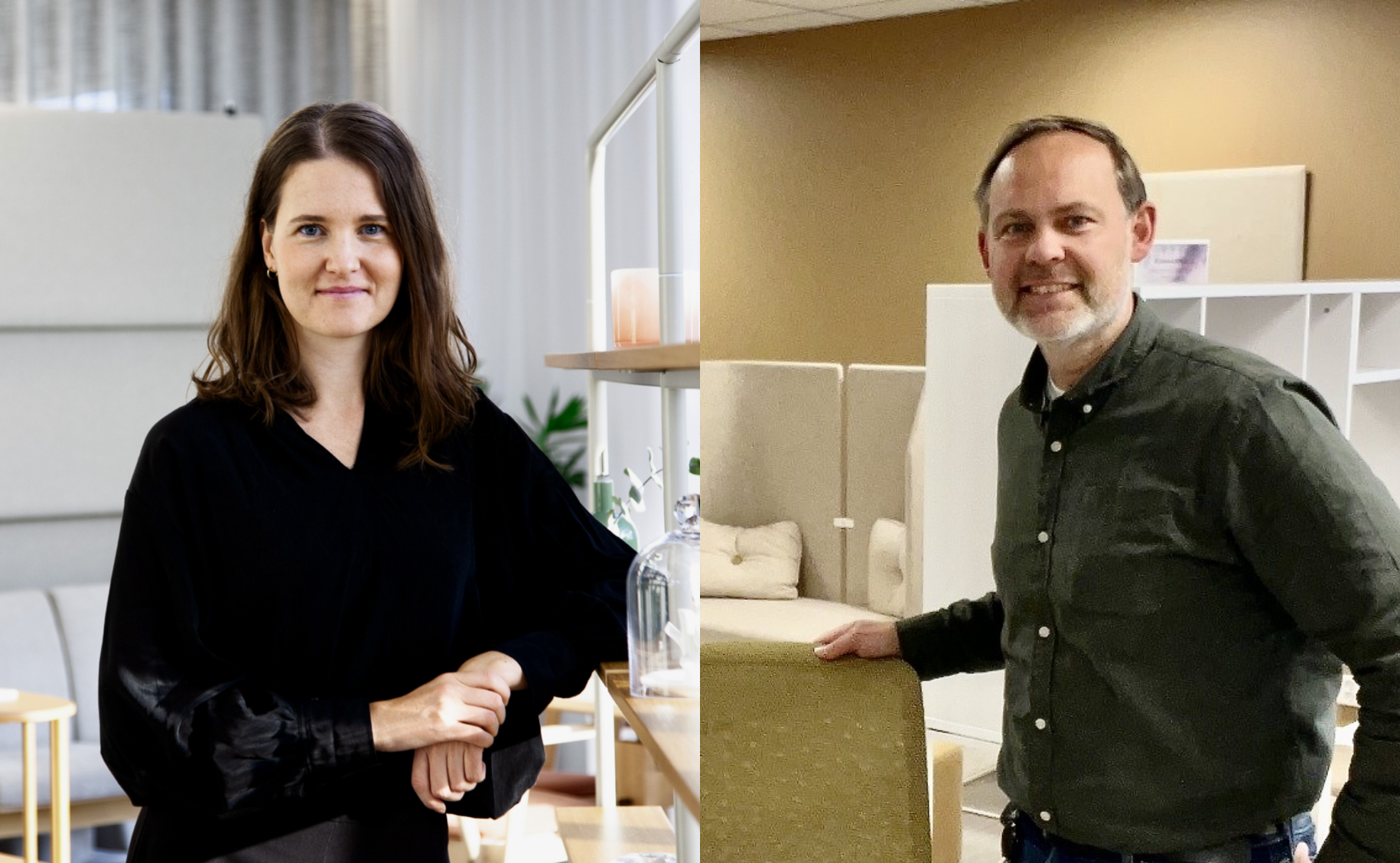
From left to right: Johanna Ljunggren, Corporate Sustainability Manager, and Marcus Söderström, R&D Manager, both at Kinnarps.
Kinnarps furniture is designed to last longer
Kinnarps is one of Europe’s leading suppliers of interior design solutions and uses a wide variety of materials in its extensive product range.
Participating in the GRACE research initiative helps the company focus its efforts on product development—to extend product lifespans and increase circularity.
You’ve probably sat in a Kinnarps chair, at a conference table, or pulled out a drawer from one of this long-established company’s shelves or filing cabinets. Kinnarps is one of Europe’s leading suppliers of furniture for offices, schools, and healthcare settings, among others, and operates in some 40 countries. But! Most of the furniture is manufactured in Sweden—in towns such as Skillingaryd, Jönköping, and, above all, in Kinnarp, where the headquarters is also located.
“It’s about both upgrading and improving the existing product line with new colors, shapes, and features, and developing entirely new products,” explains Marcus Söderström, Head of Development. Currently popular among customers are open lounge areas featuring a mix of different work environments and personal storage in a shared space.
But Marcus Söderström also sees another trend—a desire to be able to renovate, maintain, and service the products in a simple and straightforward way.
“People want the option to replace an armrest, a tabletop, and wear-and-tear parts. It’s a matter of cost—it’s cheaper to buy new armrests than an entire chair—but it’s also about circularity and sustainability-based procurement requirements from the client,” he says, noting how this very approach led to a brand-new school in Östergötland recently being furnished with reused chairs and benches.
The impact must be ensured
Some form of circularity requirement is included in nearly all of Kinnarps’ transactions. The company supplies replacement parts and assists customers daily who request new seats, fabrics, and tabletops. Ideally, repairs are made on-site to avoid shipping bulky furniture back and forth. The company works with recycled wood, metal, and plastic and also offers a selection of recycled fabrics. Fabric scraps are repurposed in production at Skillingaryd and turned into sound-absorbing products. In addition, Kinnarps strives for a “platform approach” that allows components and products to be used in a variety of different products.
“Sustainability is incredibly important to us and one of our core values,” says Johanna Ljunggren, who is the company’s sustainability manager and also serves on the Delegation for the Circular Economy, an advisory body to the government.
Circularity is one of six focus areas that Kinnarps has identified when it comes to sustainability and furniture.
“It’s a tool for reducing waste, the extraction of virgin raw materials, and climate impact, and you have to ensure that circularity actually has those effects on sustainability—that’s when it gets interesting,” says Johanna Ljunggren. “It’s often linked to products that last a long time and whose lifespan can be extended,” she explains.
Solving Tough Challenges Together
Participating in GRACE involves collaborating with other companies facing similar challenges, but in different industries. It’s easier to share facts when there’s no competition within the group, and that provides valuable insight, says Marcus Söderström. In addition, the research collaboration provides support for exploring new methods and tools for addressing issues that are difficult to tackle alone and that affect all participants—such as how to calculate the carbon footprint when selecting materials, he explains.
For Kinnarps, GRACE also serves as a “roadmap” for sustainability efforts—something to guide the way and remind everyone of the destination.
“It gives us a bit of a push and a reason to come together across departments in the company—‘now this needs to be done,’” explains Johanna Ljunggren.
They agree that the list of activities currently in place at the company likely wouldn’t have come about without the research collaboration.
The transition may mean that Kinnarps’ products will need to be modified, says Marcus Söderström as he looks ahead. A sofa might have to be shorter if you can’t choose the material you want for a load-bearing beam. And he points out that circularity must be efficient—installing new components or repainting a product must not become too labor-intensive.
There are more changes underway that affect Kinnarps and its head of development. Right now, Marcus Söderström is working on developing chairs with fewer features for the modern, mobile workplace.
“People don’t sit for eight hours—just half an hour—and multiple people use the same chair. So you don’t need all those advanced adjustments; perhaps just the backrest angle is enough,” he explains.
In other words, greater circularity—not only in Kinnarps’ production but also among those who use the company’s products.


